Lila Sciences Pioneers 'Scientific Superintelligence' with Autonomous AI Labs
Lila Sciences Pioneers 'Scientific Superintelligence' with Autonomous AI Labs
In a bold move that could fundamentally reshape scientific discovery, startup Lila Sciences has emerged with a mission to build what it calls "scientific superintelligence." Backed by $550 million in funding, the Cambridge, Massachusetts-based company is developing a network of autonomous laboratories—AI Science Factories (AISF™)—designed to automate the entire scientific method across life sciences, chemistry, and materials science.
Founded in 2023 by Flagship Pioneering, the venture firm behind Moderna, Lila Sciences isn't merely automating lab tasks. The company is fundamentally rethinking how discovery happens, empowering AI to design, execute, observe, and iterate on experiments in a continuous, self-improving loop that generates novel data and insights.
The AI Science Factory: A Self-Improving Discovery Engine
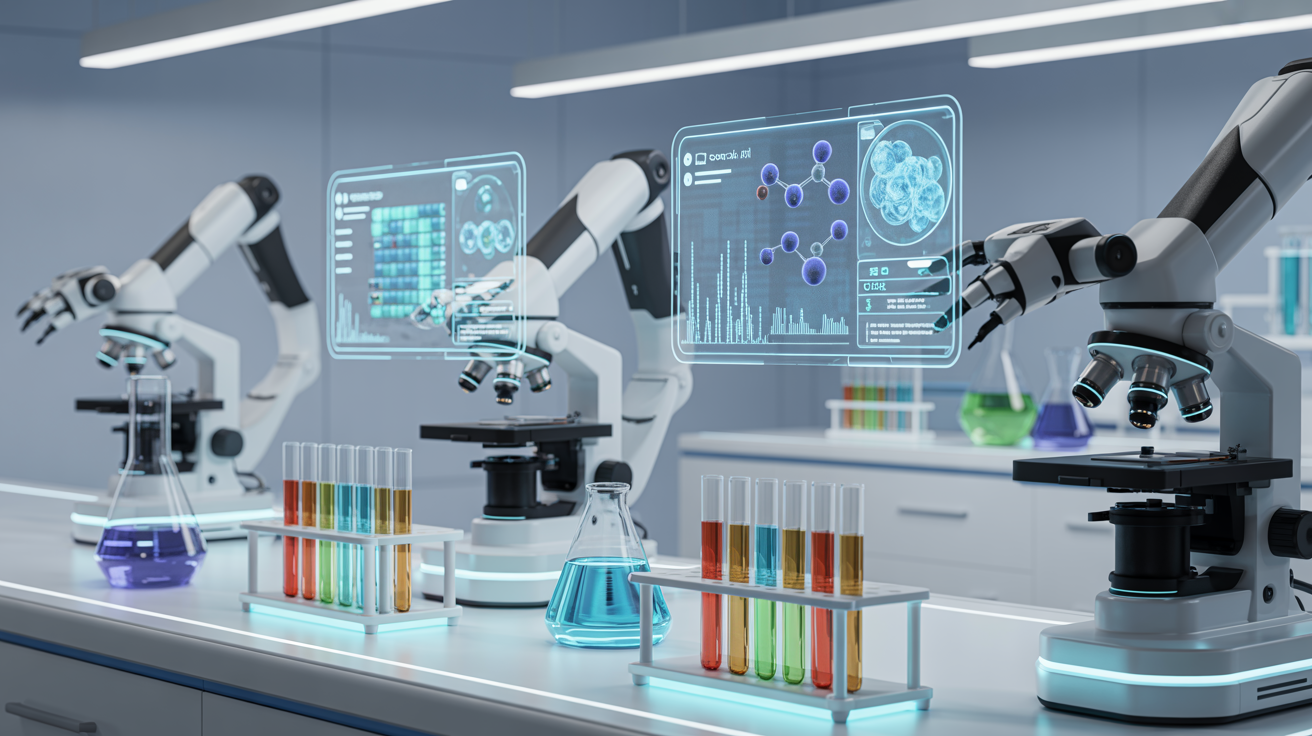
At the heart of Lila's vision is the AI Science Factory, a sophisticated platform that serves as the physical "body" for a superintelligent scientific "mind." Described as a "scientific-method machine," the AISF integrates AI models, proprietary software, and custom robotics into a closed-loop system that operates 24/7 with minimal human oversight.
The workflow operates in a continuous four-stage cycle:
- Hypothesis Generation: The process begins with a high-level goal from a human scientist, such as "discover a more efficient catalyst for green hydrogen." Lila's large-scale scientific language models, trained on vast corpuses of public and proprietary data, reason through underlying scientific principles to generate and rank potential hypotheses.
- Experiment Design: A specialized "orchestrator agent" translates the AI's most promising ideas into precise, executable laboratory protocols, detailing every parameter from microliter-level volumes to reaction temperatures and analytical measurements.
- Autonomous Execution: The physical AISF, equipped with general-purpose lab robots, automated liquid handlers, bioreactors, and high-throughput screening stations, carries out the intricate protocols. These experiments are designed by the AI specifically for the automation hardware, ensuring seamless workflow.
- Real-Time Learning and Iteration: As experiments conclude, integrated analytical instruments like mass spectrometers and imaging systems capture high-fidelity data. This information is immediately fed back into the AI models, which learn from physical results—including successes, failures, and real-world constraints—enabling superior hypotheses for the next cycle.
This self-improving loop, based on large-scale reinforcement learning, allows the system to run thousands of experiments in parallel, constantly refining its understanding and accelerating the path to discovery.
Beyond Internet Data: A New Path to AGI
Lila Sciences' approach represents a significant departure from the prevailing AI paradigm, which largely focuses on scaling models trained on existing internet data. The company's leadership argues that true intelligence, particularly scientific intelligence, cannot be achieved by simply mastering recorded knowledge.
"There's this palpable hope that if you keep doing more of that, you're going to get these generalized AGI superintelligence capabilities," said Andy Beam, CTO of AI Research at Lila Sciences. "We just have a pretty firm belief that you actually have to learn to do science. You actually have to do experiments. We have this pretty core belief that internet data is only going to get you so far."
This philosophy is rooted in the concept of open-endedness, a sub-field of AI focused on enabling systems to innovate and pursue novelty without predefined objectives. Kenneth Stanley, Lila's SVP of Open-endedness and a former research lead at OpenAI, believes this is essential for genuine creativity. "If you can't actually hack being genuinely creative, you're not at the human level, no matter what else you can do," Stanley stated.
By creating its own proprietary datasets through physical experimentation, Lila's AI learns directly from reality. This generates what the company calls "scientific tokens"—verifiable, information-dense data that trains the AI to have "interesting ideas," a crucial step toward Artificial General Intelligence (AGI). As CEO Geoffrey von Maltzahn explained, "Most AI in science runs out of things to learn because it's trained only on public data. The next leap forward will come from AI that creates its own data."
Early Breakthroughs Across Three Domains
Though still in its early years, Lila's platform has already demonstrated capabilities that exceed human and existing AI benchmarks across its three target domains.
Life Sciences
In medicine and diagnostics, Lila's AI agents are designing and validating novel therapeutics. The company reports that its systems can complete workflows in minutes or hours that traditionally take human teams days or weeks. Early successes include generation of optimal genetic medicine constructs that have outperformed commercially available therapeutics, and discovery and validation of hundreds of novel antibodies, peptides, and binders for therapeutic targets in areas like cancer, obesity, and immune disorders.
Chemistry
The platform is being applied to discover new catalysts and chemical synthesis pathways critical for clean energy and sustainability. Noteworthy achievements include generation of unique non-platinum group metal catalysts for green hydrogen production, reported to be significantly more cost-effective than current commercial options.
Materials Science
Lila is accelerating the discovery of advanced materials for next-generation manufacturing, computing, and environmental solutions. Key developments include discovery of a portfolio of advanced sorbent materials with superior capacity, thermal stability, and kinetic binding for carbon capture compared to existing products, as well as exploration of ultra-stable metals, new polymers, and engineered thin films for future technologies.
Critical Perspectives on Autonomous Science
The advent of platforms like Lila's, while promising, also raises fundamental questions about the future of scientific practice and governance. Critics and ethicists point to several key concerns:
Accountability and Oversight: As AI takes on more decision-making, questions of accountability for errors or unintended consequences become complex. The historical ideal of scientific self-governance is challenged, with some advocating for greater public oversight to ensure research aligns with societal values and the public good.
The Influence of Funding: The significant capital required for "big science" and autonomous labs creates pressure for commercially viable outcomes. This could steer research priorities away from pure, curiosity-driven inquiry toward more profitable, mission-oriented goals, potentially neglecting areas of significant public benefit that lack a clear path to monetization.
The Evolving Role of the Human Scientist: While Lila emphasizes a partnership between human ingenuity and AI, the increasing autonomy of these systems prompts a re-evaluation of the human role. The debate continues on whether AI will simply augment human creativity or eventually supplant the intuition, serendipity, and critical interpretation that have long been hallmarks of human scientific genius.
The Future: An 'AWS of Science'
Lila Sciences envisions a future where its AI Science Factories operate as shared infrastructure for research and development, akin to an "AWS of science." The company plans to open its platform to enterprise partners in the pharmaceutical, energy, and semiconductor industries, allowing them to outsource parts of their R&D pipelines to Lila's learning factories.
With $550 million in funding from a syndicate including Flagship Pioneering, General Catalyst, ARK Venture Fund, and Nvidia's venture arm (NVentures), Lila is rapidly scaling. The company is expanding its facilities in Cambridge, MA, and opening new hubs in Boston, San Francisco, and London to house its growing network of AI Science Factories.
"Lila's mission to responsibly achieve Scientific Superintelligence is born out of the belief that this is the most important opportunity of our time," said CEO Geoffrey von Maltzahn. "The teams who can turn that wheel with the highest intelligence, at the largest scale, and at the greatest speed will deliver the most transformative advances."
If successful, Lila Sciences will not just accelerate the pace of discovery; it may fundamentally change what it means to "do science," ushering in an era where autonomous AI becomes a primary engine of human knowledge and progress.
Sources & References
AI-Assisted Content Disclosure
This article was generated with AI assistance. The content is based on information from the cited sources above. While we strive for accuracy, AI-generated content may contain errors or omissions. We recommend verifying important information with the original sources before making decisions based on this content.